DOI:
https://doi.org/10.64539/msts.v2i2.2026.513Keywords:
Multi-Level QoS, Buffered Handoff System, Service Differentiation, Prioritization, Service ClassificationAbstract
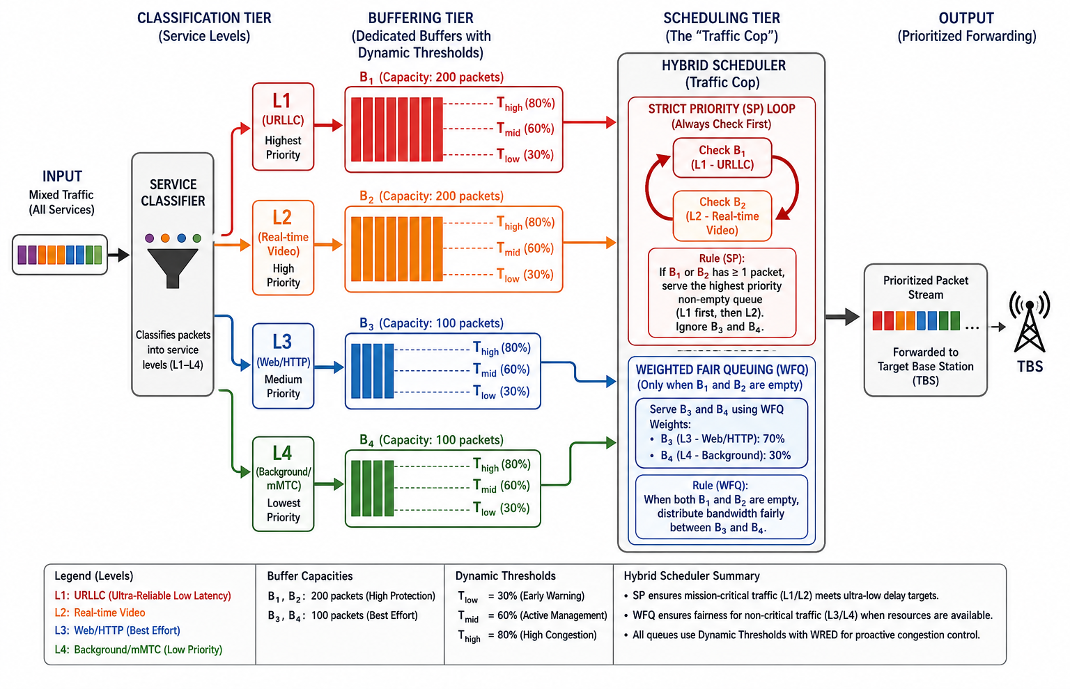
In modern wireless networks, efficient handoff strategies are crucial for several services with various Quality of Service (QoS) requirements. However, a significant research gap exists as most current handoff techniques treat all internet traffic uniformly, leading to performance degradation, latency, and glitches for time-sensitive applications like Ultra-Reliable Low Latency Communication (URLLC) during network transitions. To address this, the main objective of this study was to develop the Multi-Level Handoff Prioritization (MLHP) framework specifically for buffered handoff setups. The MLHP system integrates three core components: a multi-level service classifier, a dedicated buffering architecture with dynamic thresholds, and a hybrid scheduling mechanism combining Strict Priority and Weighted Fair Queuing. Simulation results reveal that MLHP significantly outperforms both traditional Non-Prioritized Buffered Handoff (NPBH) and Dynamic Queue Management (DQM) schemes. Key findings indicate that MLHP maintains a low dropping probability of approximately 6% under high handoff frequencies and achieves an aggregate throughput exceeding 44 Mbps during high mobility scenarios, while successfully maintaining sub-10 ms delays specifically for mission-critical URLLC traffic. The broader implications of this study suggest that MLHP provides a scalable and flexible solution for handoff management, effectively meeting the stringent requirements of 5G-and-beyond networks. By ensuring granular service differentiation, the framework enhances overall network reliability and user experience in increasingly heterogeneous mobile environments.
References
[1] I. Shayea, M. Ergen, M. H. Azmi, S. A. Çolak, R. Nordin, Y. I. Daradkeh, “Key Challenges, Drivers and Solutions for Mobility Management in 5G Networks: A Survey,” IEEE Access, vol. 8, pp. 172534 – 172552, 2020. https://doi.org/10.1109/ACCESS.2020.3023802.
[2] Y. Ullah, M. B. Roslee, S. M. Mitani, S. A. Khan, and M. H. Jusoh, “A survey on handover and mobility management in 5G HetNets: Current state, challenges, and future directions,” Sensors, vol. 23, no. 11, p. 5081, Jun. 2023. https://doi.org/10.3390/s23115081.
[3] G. Kumar, M. Varshney, and P. K. Srivastava, “Handoff management advances in enhancing mobility management in 5G networks,” African J. Biomedical Res., vol. 27, no. 4S, pp. 5590–5604, 2024. https://doi.org/10.53555/AJBR.v27i4S.4649.
[4] O. O. Erunkulu, A. M. Zungeru, C. K. Lebekwe, M. Mosalaosi, and J. M. Chuma, “5G mobile communication applications: A survey and comparison of use cases,” IEEE Access, vol. 9, pp. 97251–97295, 2021. https://doi.org/10.1109/ACCESS.2021.3093213.
[5] B. Adhikari, M. Jaseemuddin, and A. Anpalagan, “Resource allocation for co-existence of eMBB and URLLC services in 6G wireless networks: A survey,” IEEE Access, vol. 12, pp. 552–581, 2024. https://doi.org/10.1109/ACCESS.2023.3343250.
[6] V. Kovtun, M. Yukhimchuk, J. A. J. Alsayaydeh, and D. Berdysheva, “Stochastic modelling of delays and buffering in 5G-IoT ecosystems with programmable P4 switches based on BMAP,” PLOS ONE, vol. 20, no. 8, Art. no. e0330526, 2025. https://doi.org/10.1371/journal.pone.0330526.
[7] H. Haile, K.-J. Grinnemo, S. Ferlin, P. Hurtig, and A. Brunstrom, “End-to-end congestion control approaches for high throughput and low delay in 4G/5G cellular networks,” Computer Networks, vol. 186, Art. no. 107692, 2021. https://doi.org/10.1016/j.comnet.2020.107692.
[8] J. Lorincz, Z. Klarin, and J. Ožegović, “A comprehensive overview of TCP congestion control in 5G networks: Research challenges and future perspectives,” Sensors, vol. 21, no. 13, Art. no. 4510, 2021. https://doi.org/10.3390/s21134510.
[9] E. E. Ekechukwu, O. C. Nosiri, and M. I. Ajumuka, “Efficient call admission control algorithm for mobility management in LTE networks,” Int. J. Netw. Commun., vol. 12, no. 1, pp. 28–38, 2022. http://article.sapub.org/10.5923.j.ijnc.20221201.02.html.
[10] H. Shih-Cheng and L. Shieh-Shing, “Fuzzy call admission control combined with distributed dynamic channel assignment and reassignment for cellular mobile systems,” EURASIP J. Wireless Commun. Netw., vol. 2015, no. 1, pp. 1–12, 2015. https://doi.org/10.1186/s13638-015-0330-5.
[11] E. U. Udo, U. Q. Oleh, and G. O. Odo, “Analysis and computer simulation of handoff decision in 4G networks,” NIPES Journal of Science and Technology Research, vol. 3, no. 4, pp. 97–108, 2021. https://journals.nipes.org/index.php/njstr/article/download/272/287.
[12] M. Abdulwaheed and S. Adeniran, “Performance analysis of cellular mobile networks for QOS optimization,” Technosci. J. Commun. Dev. Africa, vol. 3, pp. 131–139, 2024. https://journals.kwasu.edu.ng/index.php/technoscience/article/view/257.
[13] B. Saoud ,I. Shayea, M. A. Alnakhli, and H. Mohamad, “Mobility and handover management in 5G/6G networks: Challenges, innovations, and sustainable solutions,” Technologies, vol. 13, no. 8, pp. 1–38, 2025. https://doi.org/10.3390/technologies13080352.
[14] E. Otsetova-Dudin., “Handoff in various mobile network technologies,” Transport and Communications, vol. 2, pp. 28–32, 2019. https://doi.org/10.26552/tac.C.2019.2.6.
[15] A. Hamarsheh, H. R. K. El-Taj, A. Al-Qerem, and M. Alauthman, “Optimizing handover performance in 5G networks using dual connectivity,” Wireless Pers. Commun., 2026. https://doi.org/10.1007/s11277-026-11944-2.
[16] T. Ankome and E. Hanada, “Reactive to predictive mobility management: A systematic review of ML-driven handover optimization in 5G and beyond,” Machine Learning and Knowledge Extraction, vol. 8, no. 5, pp. 1–29, 2026. https://doi.org/10.3390/make8050133.
[17] M. Mukhtar, F. Yunus, A. S. Mohd Noor, Z. Ali, M. Junaid, and M. Ahmed, “Handoff decision-making in 5G cellular networks using deep learning,” Computers, Materials & Continua, vol. 87, no. 3, 2026. https://doi.org/10.32604/cmc.2026.076246.
[18] Y. Wei, C.-H. Lung, S. A. Ajila, and R. Paredes Cabrera, “Pre-connect handover management for 5G networks using multi-agent deep Q-networks,” IEEE Access, vol. 13, pp. 176176–176197, 2025. https://doi.org/10.1109/ACCESS.2025.3618587.
[19] J. R. Behera, A. L. Imoize, S. S. Singh, S. S. Tripathy, and S. Bebortta, “Optimizing priority queuing systems with server reservation and temporal blocking for cognitive radio networks,” Telecom, vol. 5, no. 2, pp. 416–432, 2024. https://doi.org/10.3390/telecom5020021.
[20] A. Nadeem, A. Ali, N. Ali, and S. Manzoor, “QoS-aware handoff framework for performance optimization in software-defined Wi-Fi networks,” Telecommunication Systems, vol. 89, no. 32, pp. 4–12, 2026. https://doi.org/10.1007/s11235-026-01410-6.
[21] D. Battulga, “Handover with buffering for distributed mobility management in software defined mobile networks,” J. Telecommun. Digit. Econ., vol. 6, no. 1, pp. 26–40, 2018. https://doi.org/10.18080/ajtde.v6n1.137.
[22] S. Nazmus and D. Rui, “A survey of quality-of-service and quality-of-experience provisioning in information-centric networks,” Network, vol. 5, no. 2, pp. 1–29, 2025. https://doi.org/10.3390/network5020010.
[23] R. Dobrescu and D. Cârciumărescu, “Interoperability of integrated services and differentiated services architectures,” U.P.B. Scientific Bulletin, vol. 71, no. 1, pp. 21–32, 2009. https://www.scientificbulletin.upb.ro/static/pdfs/full9873.pdf.
[24] D. Strzęciwilk, “Differentiated service quality analysis based on QoS traffic prioritisation,” International Journal of Electronics and Telecommunications, vol. 71, no. 1, pp. 285–292, 2025. https://doi.org/10.24425/ijet.2025.153572.
[25] P. E. Ugege, T. E. Akhigbe-Mudu, B. A. Saka, and S. A. Akee, “A flexible handoff prioritization scheme for improved quality of service in mobile networks,” Journal of Information Engineering and Applications, vol. 11, no. 1, pp. 18–28, 2021. https://doi.org/10.7176/JIEA/11-1-03.
[26] B. Malakreddy, I. S. Rajesh, H. G. Mohan, U. N. Ranjitha, M. S. Krishnamurthy, and C. Maithri, “FLQL-VANET: A hybrid of fuzzy logic and Q-learning schemes for QoS-aware routing in VANET,” Int. J. Intell. Eng. Syst., vol. 17, no. 6, pp. 1268–1283, 2024. https://doi.org/10.22266/ijies2024.1231.92.
[27] R. Men, X. Fan, A. Shan, and G. Yuan, “Fuzzy logic based binary computation offloading scheme in V2X communication networks,” IEEE Access, vol. 12, pp. 45507–45518, 2024. https://doi.org/10.1109/ACCESS.2024.3376607.
[28] M. Abbasi, A. Shahraki, M. J. Piran, and A. Taherkordi, “Deep reinforcement learning for QoS provisioning at the MAC layer: A survey,” Eng. Appl. Artif. Intell., vol. 102, Art. no. 104234, 2021. https://doi.org/10.1016/j.engappai.2021.104234.
[29] T. S. Kumar, R. Mardeni, J. Jayapradha, U. Yasir, S. Chilakala, M. I. M. Sufian, F. O. Anwar, and Z. A. Fatimah, “Advanced handover optimization (AHO) using deep reinforcement learning in 5G networks,” Journal of King Saud University Computer and Information Sciences, vol. 37, no. 115, pp. 1–14, 2025. https://doi.org/10.1007/s44443-025-00124-0.
[30] A. M. Anwar, M. Shehata, S. M. Gasser, and H. El Badawy, “Handoff scheme for 5G mobile networks based on Markovian queuing model,” J. Adv. Res. Appl. Sci. Eng. Technol., vol. 30, no. 3, pp. 348–361, 2023. https://doi.org/10.37934/araset.30.3.348361.