DOI:
https://doi.org/10.64539/msts.v2i1.2026.485Keywords:
Peer-to-peer payments, Online escrow service, Fraud mitigation, Trust-based systems, E-commerce securityAbstract
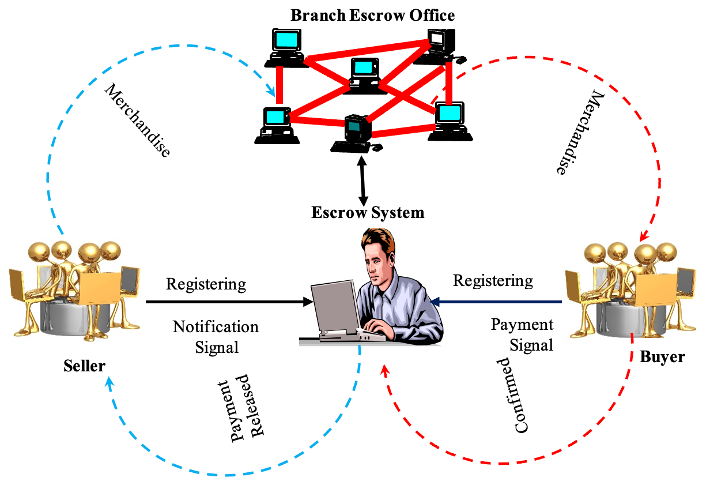
The rapid growth of peer-to-peer (P2P) online commerce has intensified concerns related to trust and fraud, particularly in informal and social-media-driven marketplaces where buyers and sellers often transact without prior relationships. Conventional online payment systems largely rely on trust-based models that inadequately protect participants from fraudulent activities, leading to financial losses and reduced user confidence. This study presents the design and implementation of an escrow-based peer-to-peer online payment system (Escrow-BP2P) aimed at providing an escrow-mediated mechanism intended to reduce fraud risks and enhance transactional trust in P2P transactions. The escrow-BP2P system introduces a trusted third-party escrow mechanism that securely holds buyer payments until transaction conditions are fulfilled and the exchanged goods or services are verified. The system architecture supports buyer, seller, and administrator roles, incorporating payment verification, transaction monitoring, dispute handling, and controlled fund release. Object-Oriented Analysis and Design Methodology (OOADM) is adopted to ensure modularity, maintainability, and system scalability, while the implementation utilizes PHP and MySQL for web-based deployment. The solution is contextualized within the Nigerian e-commerce environment, where online fraud remains a significant challenge. The escrow-BP2P framework demonstrates how structured transaction mediation can improve transactional trust, minimize fraudulent practices, and provide an escrow-based payment management platform for P2P online commerce. The system offers practical insights for deploying trust-enhancing payment infrastructures in emerging digital marketplaces.
References
[1] D. Alabi, S. Galhotra, S. Mehnaz, Z. Song, and E. Wu, “Privacy and security in distributed data markets,” in Proc. Companion 2025 Int. Conf. Management of Data, 2025, pp. 775-787. https://doi.org/10.1145/3722212.3726008.
[2] A. Agarwal, M. A. Dahleh, and T. Sarkar, “A marketplace for data: An algorithmic solution,” in Proc. 2019 ACM Conf. Economics and Computation (EC), Phoenix, AZ, USA, Jun. 2019, pp. 701–726. https://doi.org/10.1145/3328526.3329589.
[3] B. An, M. Xiao, A. Liu, G. Gao, and H. Zhao, “Truthful crowdsensed data trading based on reverse auction and blockchain,” in Proc. 24th Int. Conf. Database Systems for Advanced Applications (DASFAA), Chiang Mai, Thailand, Apr. 2019, pp. 292–309, https://doi.org/10.1007/978-3-030-18576-3_18.
[4] S. A. Azcoitia and N. Laoutaris, “A survey of data marketplaces and their business models,” ACM SIGMOD Rec., vol. 51, no. 3, pp. 18–29, 2022, https://doi.org/10.1145/3572751.3572755.
[5] R. C. Fernandez, “Protecting data markets from strategic buyers,” in Proc. 2022 Int. Conf. Management of Data (SIGMOD), 2022, pp. 1755–1769, https://doi.org/10.1145/3514221.3517855.
[6] X. Fan, L. Liu, R. Zhang, Q. Jing, and J. Bi, “Decentralized trust management: Risk analysis and trust aggregation,” ACM Comput. Surv., vol. 53, no. 1, pp. 1–33, 2020, https://doi.org/10.1145/3362168.
[7] R. C. Fernandez, P. Subramaniam, and M. J. Franklin, “Data market platforms: Trading data assets to solve data problems,” in Proc. VLDB Endow., vol. 13, no. 12, pp. 1933–1947, 2020, https://doi.org/10.14778/3407790.3407800.
[8] M. Han, J. Light, S. Xia, S. Galhotra, R. C. Fernandez, and H. Xu, “Optimal Pricing for Data-Augmented AutoML Marketplaces,” arXiv preprint arXiv:2310.17843, 2023. https://doi.org/10.48550/arXiv.2310.17843.
[9] K. Jung and S. Park, “Privacy bargaining with fairness: Privacy-price negotiation system for applying differential privacy in data market environments,” in Proc. 2019 IEEE Int. Conf. Big Data, 2019, pp. 1389–1394, https://doi.org/10.1109/BigData47090.2019.9006101.
[10] J. Ray, S. Menon, and V. Mookerjee, “Bargaining over data: When does making the buyer more informed help?” Inf. Syst. Res., vol. 31, no. 1, 2020, https://doi.org/10.1287/isre.2019.0872.
[11] P. Shang, Y. Liu, E. Sorguc, and Y. Han, “Bifdata: A secure data trading marketplace platform based on blockchain technology and smart contracts,” in Proc. Int. Conf. Service Science, 2023, pp. 138–150, https://doi.org/10.1007/978-981-99-4402-6_10.
[12] J. Zhang et al., “A survey on data markets,” arXiv preprint arXiv:2411.07267, 2024, https://doi.org/10.48550/arXiv.2411.07267.
[13] M. Zhang, F. Beltran, and J. Liu, “Selling data at an auction under privacy constraints,” in Proc. Conf. Uncertainty in Artificial Intelligence (UAI), 2020, pp. 669–678. https://proceedings.mlr.press/v124/zhang20b/zhang20b.pdf.
[14] M. Zhang and J. Pei, “Protecting data buyer privacy in data markets,” IEEE Internet Comput., vol. 28, no. 2, pp. 14–20, 2024, https://doi.org/10.1109/MIC.2024.3398626.
[15] X. Chen, J. Lai, C. Lin, X. Huang, and D. He, “Cryptographic primitives in script-based and scriptless payment channel networks: A survey,” ACM Comput. Surv., vol. 57, no. 10, Art. no. 264, May 2025, https://doi.org/10.1145/3725846.
[16] G. Malavolta, P. Moreno-Sanchez, A. Kate, M. Maffei, and S. Ravi, “Concurrency and privacy with payment-channel networks,” in Proc. 2017 ACM SIGSAC Conf. Computer and Communications Security (CCS), 2017, pp. 455–471, https://doi.org/10.1145/3133956.3134096.
[17] U. Onwudebelu and O. O. Fasola, “Formal Architecture and Performance Verification of a Blockchain-Based Decentralized Credential System”, Journal of Systematic and Modern Science Research, vol. 11, no. 9, 2026, pp. 69-101. https://doi.org/10.70382/10.70382/bejsmsr.v11i9.025.
[18] G. Avarikioti, R. Scheuner, and R. Wattenhofer, “Payment networks as creation games,” in Proc. ESORICS 2019 Workshops (DPM/CBT), Luxembourg, 2019, pp. 195–210, https://doi.org/10.1007/978-3-030-31500-9_12.
[19] A. Miller, I. Bentov, S. Bakshi, R. Kumaresan, and P. McCorry, “Sprites and state channels: Payment networks that go faster than lightning,” in Proc. Int. Conf. Financial Cryptography and Data Security, 2019, pp. 508–526, https://doi.org/10.1007/978-3-030-32101-7_30.
[20] N. Papadis and L. Tassiulas, “Blockchain-based payment channel networks: Challenges and recent advances,” IEEE Access, vol. 8, pp. 227596–227609, 2020, https://doi.org/10.1109/ACCESS.2020.3046020.
[21] J. Lind, I. Eyal, P. Pietzuch, and E. G. Sirer, “Teechan: Payment channels using trusted execution environments,” arXiv preprint arXiv:1612.07766, 2016. https://doi.org/10.48550/arXiv.1612.07766.
[22] Y. Zhang, X. Jia, B. Pan, J. Shao, L. Fang, R. Lu, and G. Wei, “Anonymous multihop payment for payment channel networks,” IEEE Trans. Dependable Secure Comput., vol. 21, no. 1, pp. 476-485, 2023, https://doi.org/10.1109/TDSC.2023.3262681.
[23] L. Aumayr, P. Moreno-Sanchez, A. Kate, and M. Maffei, “Blitz: Secure multi-hop payments without two-phase commits,” in Proc. 30th USENIX Security Symp., 2021, pp. 4043–4060. https://www.usenix.org/system/files/sec21-aumayr.pdf.
[24] Z. Liu, A. Yang, J. Weng, T. Li, H. Zeng, and X. Liang, “GMHL: Generalized multi-hop locks for privacy-preserving payment channel networks,” Cryptology ePrint Archive, Rep. 2022/115, 2022. https://eprint.iacr.org/2022/115.pdf.
[25] M. Jourenko, M. Larangeira, and K. Tanaka, “Payment trees: Low collateral payments for payment channel networks,” in Proc. 25th Int. Conf. Financial Cryptography and Data Security (FC), 2021, pp. 189–208, https://doi.org/10.1007/978-3-662-64331-0_10.
[26] J. Wang, S. Gao, G. Li, K. Gai, and B. Xiao, “SAMCU: Secure and anonymous multi-channel updates in payment-channel networks,” IEEE Trans. Inf. Forensics Security, vol. 19, pp. 9115–9128, 2024, https://doi.org/10.1109/TIFS.2024.3451366.
[27] S. Castelo, R. Rampin, A. Santos, A. Bessa, F. Chirigati, and J. Freire, “Auctus: A dataset search engine for data discovery and augmentation,” in Proc. VLDB Endow., vol. 14, no. 12, pp. 2791–2794, 2021, https://doi.org/10.14778/3476311.3476346.
[28] Z. Ying, Q. Ding, W. Li, S. Xu, and J. Xiong, “Towards scalable and secure IoT transactions: A new bi-directional payment channel without third-party monitoring,” in Proc. Australasian Conf. Information Security and Privacy, 2024, pp. 120–139, https://doi.org/10.1007/978-981-97-5101-3_7.