DOI:
https://doi.org/10.64539/msts.v2i2.2026.559Keywords:
Enterprise Integration, Event Mesh, Event-Driven Architecture, Publish/Subscribe, Multi-Cloud Integration, Hybrid Integration, Reference Architecture, Agentic AI, Model Context Protocol, Enterprise Architecture, Real-Time Systems, Distributed MessagingAbstract
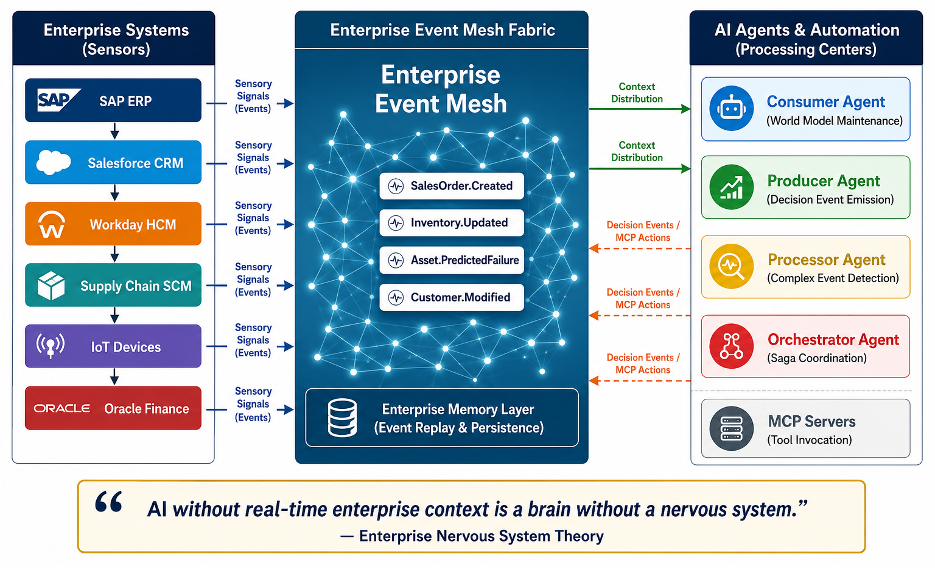
Modern enterprises integrate heterogeneous on-premises, multi-cloud, SaaS, IoT, and AI-enabled systems, creating coordination, scalability, resilience, governance, and real-time context challenges for conventional integration approaches. Although Event-Driven Architecture and event streaming are established, the literature provides limited vendor-neutral guidance that integrates Event Mesh federation, event governance, observability, hybrid-cloud deployment, and selected agentic-AI integration concerns into one enterprise reference framework. This study proposes the Enterprise Event Mesh Reference Architecture (EEMRA) to address that gap. Using Design Science Research Methodology, the study identifies the integration problem, synthesizes prior literature, develops the EEMRA artifact, performs a qualitative capability comparison, and examines illustrative enterprise cases. The framework organizes enterprise systems, event enablement and production, the Event Mesh fabric, integration services, event consumers, and cross-cutting governance and observability. Principal contributions include EEMRA, a six-responsibility architecture model, the Enterprise Event Taxonomy Framework, an Agentic Integration Architecture, an Event Mesh + Model Context Protocol integration pattern, and the Enterprise Nervous System Principle. Findings indicate that Event Mesh can provide a useful asynchronous, federated integration substrate for event-reactive workloads, while performance and business-impact claims remain implementation-dependent and are not experimentally validated in this study. The broader implication is a structured, vendor-neutral basis for designing governed event fabrics and integrating them with broader AI-agent architectures.
References
[1] A. Roy, “The Fourth Industrial Revolution,” Journal of International Consumer Marketing, vol. 32, no. 3, pp. 268–270, 2020. https://doi.org/10.1080/08961530.2020.1727164.
[2] O. Zimmermann, C. Pautasso, G. Hohpe and B. Woolf, “A Decade of Enterprise Integration Patterns: A Conversation with the Authors,” IEEE Software, vol. 33, no. 1, pp. 13-19, Jan.-Feb. 2016. https://doi.org/10.1109/MS.2016.11.
[3] G. Hohpe and B. Woolf, Enterprise Integration Patterns: Designing, Building, and Deploying Messaging Solutions. Boston, MA: Addison-Wesley, 2003. https://ptgmedia.pearsoncmg.com/images/9780321200686/samplepages/0321200683.pdf.
[4] B. Stopford, Designing Event-Driven Systems. Sebastopol, CA: O’Reilly Media, 2018. https://www.oreilly.com/library/view/designing-event-driven-systems/9781492038252/.
[5] M. Kleppmann, Designing Data-Intensive Applications. Sebastopol, CA: O’Reilly Media, 2017. https://www.oreilly.com/library/view/designing-data-intensive-applications/9781491903063.
[6] L. Wang et al., “A survey on large language model based autonomous agents,” Frontiers of Computer Science, vol. 18, no. 6, p. 186345, 2024. https://doi.org/10.1007/s11704-024-40231-1.
[7] K. Peffers, T. Tuunanen, M. Rothenberger, and S. Chatterjee, “A design science research methodology for information systems research,” Journal of Management Information Systems, vol. 24, no. 3, pp. 45-77, 2014. https://doi.org/10.2753/MIS0742-1222240302.
[8] M. Papazoglou and W.-J. van den Heuvel, “Service oriented architectures: Approaches, technologies and research issues,” The VLDB Journal, vol. 16, no. 3, pp. 389-415, Jul. 2007. https://doi.org/10.1007/s00778-007-0044-3.
[9] L. Wang and X. Li, “An Empirical Study on the Performance of ESB Applications,” in 2018 5th International Conference on Systems and Informatics (ICSAI), 2018. https://doi.org/10.1109/ICSAI.2018.8599477.
[10] T. Erl, R. Puttini, and Z. Mahmood, Cloud Computing: Concepts, Technology and Architecture. Upper Saddle River, NJ: Prentice Hall, 2013. https://ptgmedia.pearsoncmg.com/images/9780133387520/samplepages/0133387526.pdf.
[11] I. Jacobson, P.-W. Ng, P. E. McMahon, I. Spence, and S. Lidman, Essence of Software Engineering, The: Applying the SEMAT Kernel: Applying the SEMAT Kernel. Boston, MA: Addison-Wesley, 2013. https://dl.acm.org/doi/abs/10.5555/2462619.
[12] C. Richardson, Microservices Patterns: With Examples in Java. Shelter Island, NY: Manning, 2018. https://ieeexplore.ieee.org/abstract/document/10280260.
[13] P. Venkiteela, “Strategic API modernization using Apigee X for enterprise transformation,” Journal of Information Systems Engineering and Management (JISEM), vol. 9, no. 4s, 2025. [Online]. Available: https://www.jisem-journal.com/index.php/journal/article/view/13168.
[14] P. Venkiteela, “Comparative analysis of leading API management platforms for enterprise API modernization,” International Journal of Computer Applications, vol. 187, no. 54, 2025. https://doi.org/10.5120/ijca2025925924.
[15] Apache Software Foundation, “Apache Kafka documentation,” Apache Kafka v3.7, 2024. [Online]. Available: https://kafka.apache.org/documentation/.
[16] J. Kreps, N. Narkhede, and J. Rao, “Kafka: A distributed messaging system for log processing,” in Proc. 6th Int. Workshop on Networking Meets Databases (NetDB), vol. 11. no. 2011, 2011. https://pages.cs.wisc.edu/~akella/CS744/F17/838-CloudPapers/Kafka.pdf.
[17] Solace Corporation, “What is an event mesh?” Solace Technical Documentation, 2023. [Online]. Available: https://solace.com/what-is-an-event-mesh/.
[18] OASIS, “Oasis advanced message queuing protocol (amqp) version 1.0.” OASIS Standard, 2012. https://docs.oasis-open.org/amqp/core/v1.0/amqp-core-complete-v1.0.pdf.
[19] OASIS, “MQTT version 5.0,” OASIS Standard, 2019. [Online]. Available: https://iotmadlab.es/wp-content/uploads/2023/10/mqtt-v5.0.pdf.
[20] SAP, “SAP Integration Suite,” SAP Help Portal, 2024. [Online]. Available: https://help.sap.com/docs/integration-suite/sap-integration-suite/advanced-event-mesh.
[21] Anthropic, “Model Context Protocol specification,” Anthropic Technical Documentation, 2024. [Online]. Available: https://modelcontextprotocol.io.
[22] P. Venkiteela, “Modernizing opportunity-to-order workflows through SAP BTP integration architecture,” International Journal of Applied Mathematics, vol. 38, no. 3s, 2025. https://doi.org/10.12732/ijam.v38i3s.141.
[23] S. R. Jaidi, “Event-Driven Asynchronous Patterns for High-Throughput Enterprise Integration,” International Journal on Recent and Innovation Trends in Computing and Communication, vol. 10, no. 12, pp. 632–647, 2022. https://doi.org/10.17762/ijritcc.v10i12.12137.
[24] J. Dunkel and R. Bruns, “Design Patterns for Event-driven Enterprise Architectures,” in Proceedings of the 14th International Conference on Enterprise Information Systems, 2012, pp. 187–192. https://doi.org/10.5220/0003971301870192.
[25] P. M. Singh, M. J. van Sinderen, and R. J. Wieringa, “Reference architecture for integration platforms,” in IEEE 21st International Enterprise Distributed Object Computing Conference (EDOC), Quebec City, QC, Canada, 2017, pp. 113–122. https://doi.org/10.1109/EDOC.2017.24.
[26] Cloud Native Computing Foundation, “CloudEvents - A specification for describing event data in a common way,” CNCF Specification v1.0.2, 2022. [Online]. Available: https://cloudevents.io.
[27] M. Fowler, “What do you mean by Event-Driven?” martinfowler.com, Feb. 2017. [Online]. Available: https://martinfowler.com/articles/201701-event-driven.html.
[28] M. Fowler, “Event sourcing,” martinfowler.com, Dec. 2005. [Online]. Available: https://martinfowler.com/eaaDev/EventSourcing.html.
[29] M. Fowler, “CQRS,” martinfowler.com, Jul. 2011. [Online]. Available: https://martinfowler.com/bliki/CQRS.html.
[30] P. Venkiteela et al., “A Vendor-Agnostic Multi-Cloud Integration Framework Using Boomi and SAP BTP,” Journal of Engineering Research and Sciences, vol. 4, no. 12, 2025. https://doi.org/10.55708/js0412001.