DOI:
https://doi.org/10.64539/msts.v2i1.2026.403Keywords:
Generative AI, User experience, UX, Service design, Speculative DesignAbstract
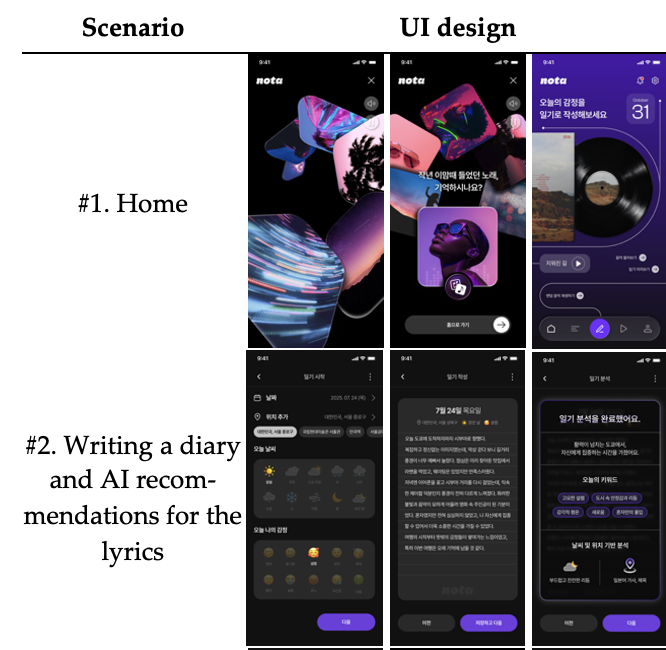
This study explores the potential of generative AI to transform diary writing into a music-based creative activity, addressing the growing significance of AI-generated content in everyday cultural practices. While prior research has examined diary-based music composition and AI music interfaces, few studies have empirically evaluated the integration of generative AI music with diary content in terms of emotional response, service perception, and usability. To bridge this gap, this study aimed to design a conceptual AI-based diary app that converts personal diary entries into lyrics and automatically generates genre-specific music reflecting contextual data (e.g., date, weather, location, and emotion). An experimental evaluation was conducted with 73 participants who listened to four AI-generated songs composed from one month of diary entries and reviewed a prototype UI. Using a 5-point Likert scale, all key factors received positive evaluations above 4.0 (emotional enthusiasm: 4.39; emotional immersion: 4.31; sympathy: 4.21; convenience: 4.23; service immersion: 4.34; retention intention: 4.19). Multiple regression analysis revealed significant positive relationships between music immersion and service awareness (p < .01), with adjusted R² values ranging from 0.241 to 0.354. The System Usability Scale score averaged 86.13, exceeding the acceptability benchmark of 75. These findings indicate that diary-based AI music services can enhance emotional immersion and user retention through convenience and personalization. The study implies strong practical potential for generative AI-driven creative services and contributes empirical evidence for future AI-based cultural content design.
References
[1] K. A. Janssens, E. H. Bos, J. G. Rosmalen, M. C. Wichers, and H. Riese, “A qualitative approach to guide choices for designing a diary study,” BMC Medical Research Methodology, vol. 18, no. 1, p. 140, 2018, https://doi.org/10.1186/s12874-018-0579-6.
[2] M. Lindström, A. Ståhl, K. Höök, P. Sundström, J. Laaksolathi, M. Combetto, and R. Bresin, “Affective diary: Designing for bodily expressiveness and self-reflection,” in CHI '06 Extended Abstracts on Human Factors in Computing Systems, 2006, pp. 1037–1042, https://doi.org/10.1145/1125451.1125649.
[3] A. Ståhl and K. Höök, “Reflecting on the design process of the Affective Diary,” in Proceedings of the 5th Nordic Conference on Human-Computer Interaction: Building Bridges, 2008, pp. 559–564, https://doi.org/10.1145/1463160.1463245.
[4] S. Feuerriegel, J. Hartmann, C. Janiesch, and P. Zschech, “Generative AI,” Business & Information Systems Engineering, vol. 66, no. 1, pp. 111–126, 2024, https://doi.org/10.1007/s12599-023-00834-7.
[5] S. Lee, AI Works and Humans Grow. Bookstone, 2024.
[6] M. Lieberman, N. I. Eisenberger, M. J. Crockett, S. M. Tom, J. H. Pfeifer, and B. M. Way “Putting feelings into words,” Psychological Science, vol. 18, no. 5, pp. 421–428, 2007, https://doi.org/10.1111/j.1467-9280.2007.01916.x.
[7] Y. Im, “Mobile Hot Talk - Personalization of My Personalized Mobile Story,” Digital Contents, no. 154, pp. 88–93, 2006.
[8] J. Kim, “The history of diary literature without drama,” Literature & Society, vol. 35, no. 4, pp. 38–52, 2022.
[9] J. Park, “Methods and examples of classics based education of content creation - Focusing on the online course of The Jehol Diary,” Journal of Humanities, no. 84, pp. 71–107, 2022, https://doi.org/10.31310/HUM.084.03.
[10] S. Lee, “Current Situaltions and Issues of the cultural Content of classical Scholars: From Database Construction to Contents Production - Focused on Case of Processing Journals of the Advanced Center For Korean Studies,” Studies in Confucianism, no. 33, pp. 29–57, 2015, https://doi.org/10.18216/yuhak.2015.33..002.
[11] J. Shin, “A study on applying Kate Hevner's ‘Adjective Circle’ on actor's training,” Master’s thesis, Dankook University, 2016.
[12] H. Kim, “Effects of popular music experience on emotional empathy,” Master’s thesis, Chung-Ang University, 2019, https://doi.org/10.23169/cau.000000230796.11052.0000465.
[13] P. N. Juslin and D. Västfjäll, “Emotional responses to music: The need to consider underlying mechanisms,” Behavioral and Brain Sciences, vol. 31, no. 5, p. 559, 2008, https://doi.org/10.1017/S0140525X08005293.
[14] J. A. Sloboda, S. A. O’Neill, and A. Ivaldi, “Functions of music in everyday life: An exploratory study using the experience sampling method,” Musicae Scientiae, vol. 5, no. 1, pp. 9–32, 2001, https://doi.org/10.1177/102986490100500102.
[15] S. Jin, “The effect of musical application to develop the emotional expression of mentally retarded adults,” Korean Journal of Music Therapy Education, vol. 2, no. 1, pp. 17–33, 2005. https://koreascience.kr/article/JAKO200518139713542.page.
[16] S. J. Cunningham, D. Bainbridge, and D. McKay, “Finding new music: A diary study of everyday encounters with novel songs,” in Proceedings of the 8th International Conference on Music Information Retrieval (ISMIR), Vienna, Austria, 2007. https://doi.org/10.25916/sut.26275825.
[17] J. W. Huang, Y. M. Chen, and C. W. You, “Music diary: Using ChatGPT to craft interactive diaries with emotional music for reflection and sharing real-life emotions,” in Companion of the 2024 ACM International Joint Conference on Pervasive and Ubiquitous Computing, Melbourne, Australia, 2024. https://doi.org/10.1145/3675094.3677550.
[18] T. DeNora, “Music as a technology of the self,” Poetics, vol. 27, pp. 31–56, 1999, https://doi.org/10.1016/S0304-422X(99)00017-0.
[19] A. Van Goethem and J. Sloboda, “The functions of music for affect regulation,” Musicae Scientiae, vol. 15, no. 2, pp. 208–228, 2011, https://doi.org/10.1177/1029864911401174.
[20] K. Jakubowski, A. M. Belfi, L. Kvavilashvili, A. Ely, M. Gill, G. Herbert, “Comparing music- and food-evoked autobiographical memories in young and older adults: A diary study,” British Journal of Psychology, vol. 114, no. 3, pp. 580–604, 2023, https://doi.org/10.1111/bjop.12639.
[21] Y. Zhang, “A study on the use of animation music contents on the MCN - Focusing on the characteristics of Chinese platform Douyin,” Doctoral dissertation, Joongbu University, 2017.
[22] S. Kim, “Development and application of a musical diary writing program for making music a way of life,” Master’s thesis, Ewha Womans University, 2014.
[23] J. Park, H. Cho, H. Chu, Y. Lee, H. Lim, “NoRe: Augmenting journaling experience with generative AI for music creation,” in Proceedings of the 2025 ACM Designing Interactive Systems Conference, 2025, pp. 2718 - 2737. https://doi.org/10.1145/3715336.3735845.
[24] A. Dunne and F. Raby, Speculative Everything. MIT Press, 2013. https://books.google.co.id/books?id=RKzIEAAAQBAJ.
[25] A. Watson and D. Lupton, “What happens next? Using the story completion method to surface the affects and materialities of digital privacy dilemmas,” Sociological Research Online, vol. 27, no. 3, pp. 690–706, 2022, https://doi.org/10.1177/13607804221084343.
[26] J. Lee, G. Lee, and W. Na, “The role of sympathy response and empathy response for understanding Korean music: Fanaticism approach,” The Korean Journal of Advertising, vol. 26, no. 2, pp. 361–391, 2015, https://doi.org/10.14377/KJA.2015.2.28.361.
[27] Y. Eom and S. Lee, “The impact of OTT service characteristics on service reuse intention: The mediating roles of perceived ease of use and content quality,” Journal of Humanities and Social Sciences, vol. 33, no. 2, pp. 357–377, 2025, https://doi.org/10.22924/jhss.33.2.202505.015.
[28] D. P. Moniz, M. Mehrnezhad, and T. Almeida, “Intimate data: Exploring perceptions of privacy and privacy-seeking behaviors through the story completion method,” in IFIP Conference on Human-Computer Interaction, 2023, pp. 533–543. https://doi.org/10.1007/978-3-031-42286-7_30.
[29] O. Ezra, A. Cohen, and D. Shany, “Human experts and generative AI interaction: From real-world and real-life language learning diary-research app to a diary-learning app,” Ubiquity Proceedings, vol. 4, no. 1, p. 19, 2024, https://doi.org/10.5334/uproc.141.
[30] Y. Kim, K. Kim, Y. Ahn, and D. Kim, “A study on the design of a generative AI-based emotional diary app service,” Advanced Industrial Science, vol. 4, no. 6, pp. 43–49, 2025, https://doi.org/10.23153/AI-Science.2025.4.6.043.