DOI:
https://doi.org/10.64539/msts.v2i2.2026.522Keywords:
Location-based mobile navigation services, User acceptance, Privacy concern, Perceived risk, Trust, Data governanceAbstract
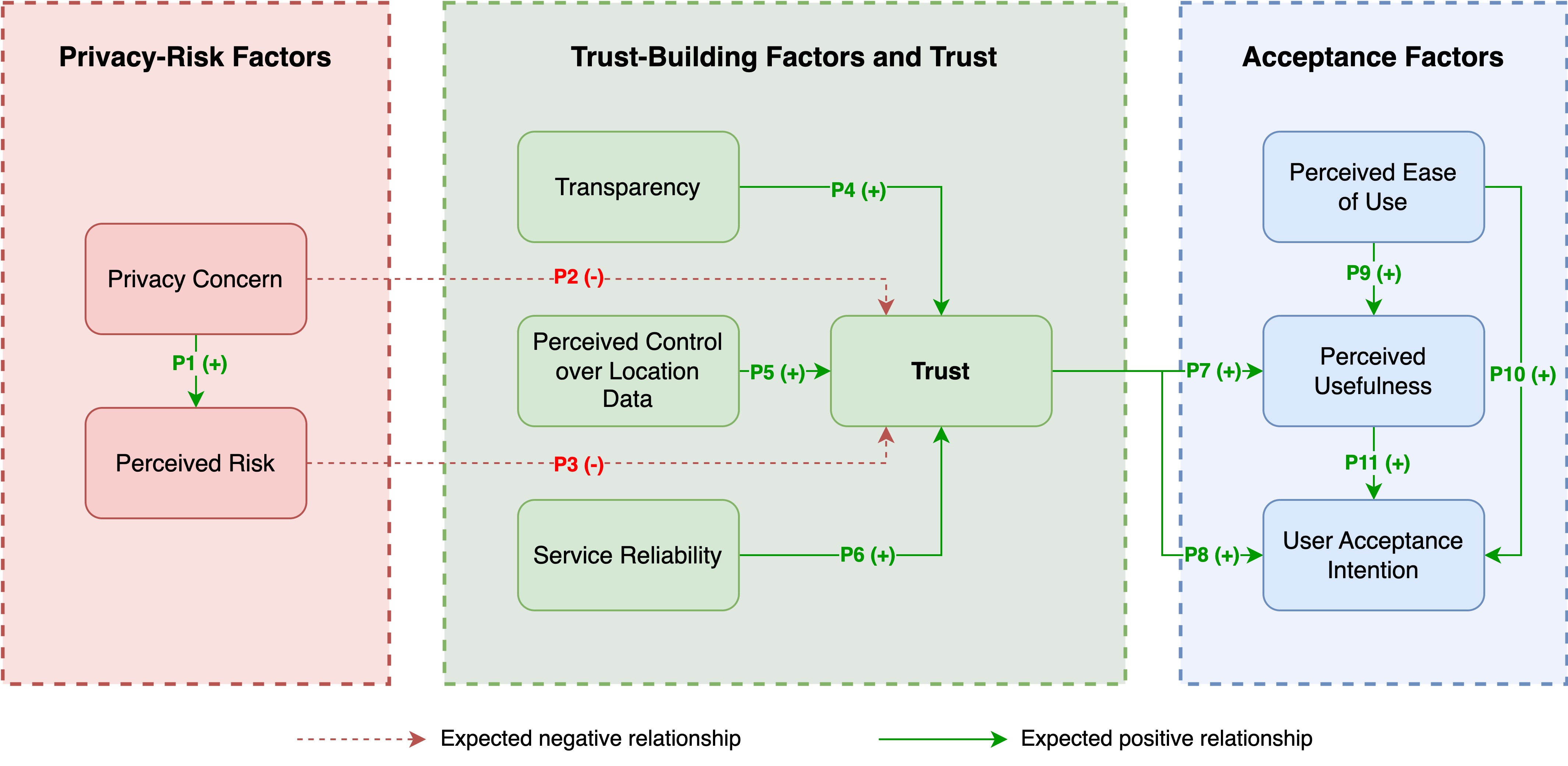
The two most important factors for location-based mobile navigation services are navigation performance and trusted data governance, especially when location data is used repeatedly. Previous studies have tended to focus on privacy concerns, perceived risk, trust, transparency, control, and service quality separately or in settings other than consumer navigation, as is the case in this study. As a result, the interaction between privacy risk perceptions and provider assurances in influencing mobile navigation acceptance remains poorly defined. This conceptual study develops a trust- and privacy-based user acceptance framework by synthesizing the literature through a structured procedure and incorporating the Technology Acceptance Model, Privacy Calculus Theory, and Trust Theory. The framework posits that privacy concern increases perceived risk, while privacy concern and perceived risk reduce trust. In contrast, transparency, perceived control over location data, and service reliability can enhance trust. The roles of perceived usefulness and user acceptance intention in the pathway to user acceptance remain unchanged, suggesting that trust is an antecedent to perceived usefulness and user acceptance intention. The framework fills the theoretical gap between privacy-risk assessment and trust-building service attributes, and between trust in technology acceptance and repeated disclosure of the location setting. It also recognizes the need for transparent data practices, meaningful location control, and reliable service performance as provisional design priorities, which require future empirical validation. The propositions are to be used as a starting point for further testing on platforms, providers, user groups, cultures, and regulatory frameworks.
References
[1] J. W. Kim, K. Edemacu, and B. Jang, “Privacy-preserving mechanisms for location privacy in mobile crowdsensing: A survey,” J. Netw. Comput. Appl., vol. 200, Art. no. 103315, Apr. 2022. https://doi.org/10.1016/j.jnca.2021.103315.
[2] G. Qiu, G. Tang, C. Li, L. Luo, D. Guo, and Y. Shen, “Differentiated location privacy protection in mobile communication services: A survey from the semantic perception perspective,” ACM Comput. Surv., vol. 56, no. 3, Art. no. 60, pp. 1–36, Mar. 2024. https://doi.org/10.1145/3617589.
[3] S. Heitmann, A. Pagotto, and C. Kray, “Approximate vs. precise location in popular location-based services,” Journal of Location Based Services, vol. 19, no. 1, pp. 1–42, 2025. https://doi.org/10.1080/17489725.2024.2310006.
[4] S. Özdal Oktay, S. Heitmann, and C. Kray, “Linking location privacy, digital sovereignty and location-based services: A meta review,” Journal of Location Based Services, vol. 18, no. 1, pp. 1–52, 2024. https://doi.org/10.1080/17489725.2023.2239180.
[5] Z. Garroussi, A. Legrain, S. Gambs, V. Gautrais, and B. Sansò, “A systematic review of data privacy in Mobility as a Service (MaaS),” Transportation Research Interdisciplinary Perspectives, vol. 31, art. 101254, 2025. https://doi.org/10.1016/j.trip.2024.101254.
[6] Y. Ge, H. Qi, and W. Qu, “The factors impacting the use of navigation systems: A study based on the technology acceptance model,” Transp. Res. Part F Traffic Psychol. Behav., vol. 93, pp. 106–117, Feb. 2023. https://doi.org/10.1016/j.trf.2023.01.005.
[7] Z. Kenesei, L. Kökény, K. Ásványi, and M. Jászberényi, “The central role of trust and perceived risk in the acceptance of autonomous vehicles in an integrated UTAUT model,” Eur. Transp. Res. Rev., vol. 17, Art. no. 8, 2025. https://doi.org/10.1186/s12544-024-00681-x.
[8] C. Varela-Neira and A. Hilal, “A UTAUT2 approach to understand intention to use mobile banking by non-users and intention to continue by users,” J. Financ. Serv. Mark., vol. 31, Art. no. 23, Feb. 2026. https://doi.org/10.1057/s41264-026-00350-1.
[9] B. Binzer, J. Kendziorra, A.-K. Witte, and T. J. Winkler, “Trust in public and private providers of health apps and usage intentions: A sectoral privacy calculus and control perspective,” Bus. Inf. Syst. Eng., vol. 66, pp. 273–297, Jun. 2024. https://doi.org/10.1007/s12599-024-00869-4.
[10] S. Cerf, B. Robu, N. Marchand, and S. Bouchenak, “Privacy protection control for mobile apps users,” Control Eng. Pract., vol. 134, Art. no. 105456, May 2023. https://doi.org/10.1016/j.conengprac.2023.105456.
[11] J.-G. Martínez-Navalón, M. Fernández-Fernández, and F. P. Alberto, “Does privacy and ease of use influence user trust in digital banking applications in Spain and Portugal?,” Int. Entrep. Manag. J., vol. 19, no. 2, pp. 781–803, Jun. 2023. https://doi.org/10.1007/s11365-023-00839-4.
[12] J. M. Lopes, I. Massano-Cardoso, and L. Pedrosa, “The role of artificial intelligence in mobile banking: Decoding Portuguese consumers’ perceptions and intentions to engage,” Future Bus. J., vol. 11, Art. no. 125, May 2025. https://doi.org/10.1186/s43093-025-00510-0.
[13] F. Bemmann and S. Mayer, “The impact of data privacy on users’ smartphone app adoption decisions,” Proc. ACM Hum.-Comput. Interact., vol. 8, no. MHCI, Art. no. 278, pp. 1–23, Sep. 2024. https://doi.org/10.1145/3676525.
[14] Y. Ma, C. Sew, Z. Sarsenbayeva, J. Knibbe, and J. Goncalves, “Understanding users’ perspectives on location privacy management on iPhones,” Proc. ACM Hum.-Comput. Interact., vol. 8, no. MHCI, Art. no. 282, pp. 1–25, Sep. 2024. https://doi.org/10.1145/3676529.
[15] Y. Jung, J. A. Bao, M. P. Norman, and S. S. Sundar, “Privacy concerns in mobile technology: Can interactivity reduce friction?,” Comput. Hum. Behav., vol. 162, Art. no. 108421, Jan. 2025. https://doi.org/10.1016/j.chb.2024.108421.
[16] A. H. Shoabjareh, M. Ghasri, T. Roberts, A. Lapworth, N. Dobos, and C. Boshuijzen-van Burken, “The role of trust and distrust in technology usage: An in-depth investigation of traffic information apps usage for mandatory and non-mandatory trips,” Travel Behav. Soc., vol. 37, Art. no. 100816, Oct. 2024. https://doi.org/10.1016/j.tbs.2024.100816.
[17] S. Huang, “Listening to users’ personal privacy concerns: The implication of trust and privacy concerns on the user’s adoption of a MaaS-pilot,” Case Studies on Transport Policy, vol. 10, no. 4, pp. 2153–2164, 2022. https://doi.org/10.1016/j.cstp.2022.09.012.
[18] N. F. A. Budi et al., “Why do people want to use location-based applications for emergency situations? The extension of UTAUT perspectives,” Technology in Society, vol. 65, art. 101480, 2021. https://doi.org/10.1016/j.techsoc.2020.101480.
[19] M. J. Bryant, S. J. Wilde, G. Coles, G. Sorwar, and V. Bui, “Mobile app usage and adoption through the lens of cognitive, affective and behavioral trust constructs,” International Journal of Human–Computer Interaction, vol. 42, no. 5, pp. 3393–3417, 2026. https://doi.org/10.1080/10447318.2025.2531289.
[20] S. Hu, L. Rong, J. Han, D. Zhang, and W. Jiang, “The effects of interaction mode and individual differences on usability and user experience of mobile augmented reality navigation,” IEEE Access, vol. 11, pp. 41783–41795, 2023. https://doi.org/10.1109/ACCESS.2023.3271522.
[21] L. Yang, Y. Bian, X. Zhao, X. Liu, and X. Yao, “Drivers’ acceptance of mobile navigation applications: An extended technology acceptance model considering drivers’ sense of direction, navigation application affinity and distraction perception,” International Journal of Human–Computer Studies, vol. 145, art. 102507, 2021. https://doi.org/10.1016/j.ijhcs.2020.102507.
[22] G. Lu, S. Qu, and Y. Chen, “Understanding user experience for mobile applications: A systematic literature review,” Discover Appl. Sci., vol. 7, Art. no. 587, Jun. 2025. https://doi.org/10.1007/s42452-025-07170-3.
[23] Y. Ma, S. Zhang, D. Yang, Z. Sarsenbayeva, J. Knibbe, and J. Goncalves, “Raising awareness of location information vulnerabilities in social media photos using LLMs,” in Proc. CHI Conf. Human Factors Comput. Syst. (CHI ’25), Yokohama, Japan, Apr. 2025, pp. 1–14. https://doi.org/10.1145/3706598.3714074.
[24] M. J. J. Gumasing, J. Y. M. Nazal, A. C. Rivera, J. R. E. Robles, and J. A.-F. C. Viray, “Exploring Gen Z adoption of Life360 technology: A study of usage patterns and perceptions,” Acta Psychol., vol. 259, Art. no. 105422, Sep. 2025. https://doi.org/10.1016/j.actpsy.2025.105422.
[25] J. Bartol, V. Vehovar, and A. Petrovčič, “Systematic review of survey scales measuring information privacy concerns on social network sites,” Telemat. Inform., vol. 85, Art. no. 102063, Nov. 2023. https://doi.org/10.1016/j.tele.2023.102063.
[26] F. Hassandoust, S. Akhlaghpour, and A. C. Johnston, “Individuals’ privacy concerns and adoption of contact tracing mobile applications in a pandemic: A situational privacy calculus perspective,” Journal of the American Medical Informatics Association, vol. 28, no. 3, pp. 463–471, 2021. https://doi.org/10.1093/jamia/ocaa240.
[27] G. Fox, T. Clohessy, L. van der Werff, P. Rosati, and T. Lynn, “Exploring the competing influences of privacy concerns and positive beliefs on citizen acceptance of contact tracing mobile applications,” Computers in Human Behavior, vol. 121, art. 106806, 2021. https://doi.org/10.1016/j.chb.2021.106806.
[28] M. Trkman, A. Popovič, and P. Trkman, “The roles of privacy concerns and trust in voluntary use of governmental proximity tracing applications,” Government Information Quarterly, vol. 40, no. 1, art. 101787, 2023. https://doi.org/10.1016/j.giq.2022.101787.
[29] S. Ying, Y. Huang, L. Qian, and J. Song, “Privacy paradox for location tracking in mobile social networking apps: The perspectives of behavioral reasoning and regulatory focus,” Technological Forecasting and Social Change, vol. 190, art. 122412, 2023. https://doi.org/10.1016/j.techfore.2023.122412.
[30] T. Fernandes and N. Pereira, “Revisiting the privacy calculus: Why are consumers (really) willing to disclose personal data online?” Telematics and Informatics, vol. 65, art. 101717, 2021. https://doi.org/10.1016/j.tele.2021.101717.
[31] N. Rodríguez-Priego, L. Porcu, and P. J. Kitchen, “Sharing but caring: Location-based mobile applications and privacy protection motivation,” Journal of Business Research, vol. 140, pp. 546–555, 2022. https://doi.org/10.1016/j.jbusres.2021.11.022.
[32] R. Aggarwal, S. Dhingra, and S. Mittal, “What reduces the privacy concerns of customers toward the use of location-based advertising? An empirical investigation,” Journal of Location Based Services, vol. 18, no. 2, pp. 139–161, 2024. https://doi.org/10.1080/17489725.2023.2256701.
[33] T. D. Oesterreich, E. Anton, F. M. Hettler, and F. Teuteberg, “What drives individuals’ trusting intention in digital platforms? An exploratory meta-analysis,” Management Review Quarterly, vol. 75, pp. 3615–3667, 2025. https://doi.org/10.1007/s11301-024-00477-2.
[34] M. S. Frangopoulou, L. N. van der Laan, and W. Ebbers, “The privacy calculus in the context of novel health technology for diagnosing and tracking infectious diseases: The role of disease severity and technology’s evidence base for effectiveness in adoption and voluntary health data-sharing,” Technol. Soc., vol. 78, Art. no. 102616, Sep. 2024. https://doi.org/10.1016/j.techsoc.2024.102616.
[35] M. S. Alzaidi and G. Agag, “The role of trust and privacy concerns in using social media for e-retail services: The moderating role of COVID-19,” Journal of Retailing and Consumer Services, vol. 68, art. 103042, 2022. https://doi.org/10.1016/j.jretconser.2022.103042.
[36] D. Dhagarra, M. Goswami, and G. Kumar, “Impact of trust and privacy concerns on technology acceptance in healthcare: An Indian perspective,” International Journal of Medical Informatics, vol. 141, art. 104164, 2020. https://doi.org/10.1016/j.ijmedinf.2020.104164.
[37] Y. Zhang, “Impact of perceived privacy and security in the TAM model: The perceived trust as the mediated factors,” International Journal of Information Management Data Insights, vol. 4, no. 2, art. 100270, 2024. https://doi.org/10.1016/j.jjimei.2024.100270.
[38] J. Kim, D. Kim, and B. David-John, “The role of privacy concerns, perceived benefits, and trust in citizens’ acceptance of street-view image collection by local planning agencies,” Cities, vol. 154, art. 105339, 2024. https://doi.org/10.1016/j.cities.2024.105339.
[39] Y. Hu and H. K. Min, “Information transparency, privacy concerns, and customers’ behavioral intentions regarding AI-powered hospitality robots: A situational awareness perspective,” J. Hosp. Tour. Manag., vol. 63, pp. 177–184, Jun. 2025. https://doi.org/10.1016/j.jhtm.2025.04.003.
[40] J. Dreyer, S. Heitmann, F. Erdmann, G. Bauer, and C. Kray, “‘Informed’ consent in popular location-based services and digital sovereignty,” Journal of Location Based Services, vol. 16, no. 4, pp. 312–342, 2022. https://doi.org/10.1080/17489725.2021.2017495.
[41] J. Cloarec, C. Cadieu, and N. Alrabie, “Tracking technologies in eHealth: Revisiting the personalization–privacy paradox through the transparency-control framework,” Technological Forecasting and Social Change, vol. 200, art. 123101, 2024. https://doi.org/10.1016/j.techfore.2023.123101.
[42] F. Bemmann, M. Windl, J. Erbe, S. Mayer, and H. Hussmann, “The influence of transparency and control on the willingness of data sharing in adaptive mobile apps,” Proceedings of the ACM on Human-Computer Interaction, vol. 6, no. MHCI, Art. no. 189, pp. 1–26, Sep. 2022. https://doi.org/10.1145/3546724.
[43] P. Mirzania, N. Balta-Ozkan, and L. Whitmarsh, “Improved convenience or a cyber security threat? Public acceptance of mobility-as-a-service in Great Britain,” Energy Res. Soc. Sci., vol. 127, Art. no. 104309, Sep. 2025. https://doi.org/10.1016/j.erss.2025.104309.
[44] F. S. Alrayes, A. I. Abdelmoty, and W. El-Geresy, “User profile visualisation for privacy awareness on Geo-Social Networks,” Journal of Location Based Services, vol. 19, no. 1, pp. 43–77, 2025. https://doi.org/10.1080/17489725.2024.2399512.
[45] H. N. Chua, J. S. Ooi, and A. Herbland, “The effects of different personal data categories on information privacy concern and disclosure,” Computers & Security, vol. 110, art. 102453, 2021. https://doi.org/10.1016/j.cose.2021.102453.
[46] L. Stocchi, N. Pourazad, N. Michaelidou, A. Tanusondjaja, and P. Harrigan, “Marketing research on mobile apps: Past, present and future,” Journal of the Academy of Marketing Science, vol. 50, no. 2, pp. 195–225, 2022. https://doi.org/10.1007/s11747-021-00815-w.
[47] S. Veronika, M. S. W. Lee, B. Lang, and P. Putra, “A systematic review and future agenda on continuance intentions in mobile apps,” International Journal of Information Management Data Insights, vol. 5, no. 2, art. 100352, 2025. https://doi.org/10.1016/j.jjimei.2025.100352.
[48] E. Jaakkola, “Designing conceptual articles: Four approaches,” AMS Review, vol. 10, pp. 18–26, 2020. https://doi.org/10.1007/s13162-020-00161-0.
[49] K. Heinonen and T. Gruen, “Elevating conceptual research: Insights, approaches, and support,” AMS Review, vol. 14, nos. 1–2, pp. 1–6, 2024. https://doi.org/10.1007/s13162-024-00283-9.
[50] W. M. Lim, “Theory and theory development: Guidelines for establishing theoretical gaps, foundations, contributions, and implications,” Journal of Business Research, vol. 202, Art. no. 115745, Jan. 2026. https://doi.org/10.1016/j.jbusres.2025.115745.
[51] M. Gusenbauer and S. P. Gauster, “How to search for literature in systematic reviews and meta-analyses: A comprehensive step-by-step guide,” Technological Forecasting and Social Change, vol. 212, Art. no. 123833, Mar. 2025. https://doi.org/10.1016/j.techfore.2024.123833.
[52] J. Paul, A. Merchant, Y. K. Dwivedi, and G. Rose, “Writing an impactful review article: What do we know and what do we need to know?” Journal of Business Research, vol. 133, pp. 337–340, 2021. https://doi.org/10.1016/j.jbusres.2021.05.005.